2026-2030 Strategic Business Plan

Reviving one of West Africa's largest integrated irrigated farms

Scalable alfalfa & forage production from Senegal's Saint-Louis region - built for the premium GCC export market.

$25.6B
Global alfalfa market
26,500 Ha
LFT concession
Aug 2026
Restart planting begins
2,000 Ha
Phase I platform
The Opportunity

Africa is the future of farming - West Africa leads

Africa holds 65% of the world's undeveloped agricultural land. Senegal pairs proven irrigated agriculture and secured water rights with Atlantic export access and GCC-aligned capital.

Secured water & land

40-year presidential concession on the Senegal River.

Atlantic gateway

DP World's Port of Dakar - most efficient in Sub-Saharan Africa.

Aligned capital

GCC logistics investment (DP World) already anchored in Senegal.

Structural demand

Persistent global shortage of premium >18% protein forage.

Market Opportunity

A premium, import-dependent GCC alfalfa market

Gulf dairy demand keeps rising while Saudi Arabia and the UAE phase out water-intensive domestic fodder - creating durable, premium-priced import demand Senegal is positioned to serve.

$350-410
GCC landed price / MT (CIF)
>100k MT
Export potential at 10,000 Ha
>18%
Protein - premium grade
~100%
GCC commercial alfalfa imported
The Asset - LFT Farms

Land, water rights & standing infrastructure

  • ~26,500 hectares under a 40-year presidential concession, scaling productive operations toward 10,000 Ha.
  • US$70M+ in prior developer investment already in the ground.
  • 106 km of water channels, pumping stations, roads, warehouses & operating bases.
  • Continuity - pivot production ongoing under Gora Seck, Africa President.

Saint-Louis

Senegal River valley location.

40-year tenure

Presidential concession, renewing with the restart.

Dual-track

Export pivots + low-input local grazing.

Solar-first

Powering 2,000 Ha at steady state.

The Resource Case

The Gulf is not importing alfalfa.  It is importing water.

Saudi Arabia did not stop growing forage because it ran out of land.  It stopped because domestic cultivation was drawing down non-renewable aquifers, and the Kingdom moved to phase out domestic green fodder production.  Every tonne the Gulf now buys abroad is a tonne of water it has chosen not to pump at home.  Which makes the origin of that water the whole question.

Saint-Louis draws on a regulated, replenishing river system rather than a fossil aquifer.  That is the difference between exporting a commodity and exporting a depletion.
Source

A governed river, not a fossil aquifer

The concession draws from the Senegal River basin, whose flows are managed jointly by Senegal, Mali, Mauritania and Guinea through the OMVS, the basin authority that regulates dam releases across the four member states.  Downstream, the Diama dam holds back Atlantic seawater and maintains a freshwater reservoir upstream for agricultural diversion.  Abstraction is licensed and regulated rather than extractive.

Constraint

Salinity, not scarcity, is the constraint

The valley is historically estuarine, so intensive pivot irrigation can mobilise salt up through the soil column where drainage is poor or where pumping outpaces local recharge.  Soil salinisation, not water scarcity, is the primary agronomic threat in Saint-Louis.  It is answered with drainage design, managed leaching cycles, pumping rates set against measured water table response, and salt-tolerant non-dormant varieties in the Group 9 and 10 fall dormancy range.

Cost

The water is there.  Moving it is the expense

Availability is not the binding constraint on this asset.  Lift is.  Diesel-powered pumping through large centre pivots puts operating cost directly on the fuel curve, the most volatile line in the budget.  Phase II moves the 2,000 Ha steady-state footprint onto solar-powered irrigation, converting a variable energy cost into a fixed one and holding landed cost per tonne competitive into the Gulf.

Licence

Measured, and shared

Drawing large volumes for a high-water-density crop is where agricultural concessions lose their social licence, because traditional pastoralists lose access to natural livestock watering points.  The master plan treats that as a design input rather than a grievance to be managed.  Water table behaviour and drainage quality are monitored and reported into the basin framework, and dedicated low-input community watering ponds sit inside the concession alongside the commercial pivots.

Community water as operating infrastructure

Community water is an operational insurance policy, not a philanthropic line item.  Where commercial farms and rural communities collide in West Africa, it is almost always over water access or cattle migration corridors.  Both are engineering problems, and both are cheaper to design for than to litigate.
Abreuvoirs

Dedicated livestock watering stations

A transhumant herder looking for water will cross a commercial pivot field to reach it, and a pivot span is an expensive thing to have cattle walk through.  Secondary lines off the main river intake feed dedicated concrete watering troughs sited outside the farm perimeter.  Herders get free, clean, reliable water without entering commercial acreage, which removes the single most common cause of farmer-herder conflict in the valley.

Shared off-take

Bulk capacity sold down to smallholder co-operatives

Neighbouring smallholders irrigate with unreliable diesel pumps, and when a pump fails the crop fails, which is where resentment toward a large commercial operation begins.  A defined fraction of bulk-pumped capacity is allocated to adjacent co-operatives on a subsidised or contract-farming basis.  Because the main station pumps at industrial scale, the marginal cost of that water is small and the local economic effect is not.

Kiosks

Solar-powered village water points

Village water in rural Saint-Louis carries pathogen and salinity risk.  Standalone solar-powered reverse osmosis kiosks deploy alongside the farm's own microgrid, operated by a local co-operative or women's committee that sells treated drinking water at a nominal price to fund its own maintenance.  The farm is the anchor technology partner rather than the operator, and the kiosk becomes a self-sustaining local business.

Catchment

Constructed wetlands inside the grazing buffer

Irrigation runoff carries residual fertiliser and salts, and discharging it untreated creates a downstream problem that eventually becomes a permitting problem.  Runoff and leaching flushes route through constructed wetlands and catchment ponds inside the community grazing buffer.  The filtered surface water feeds pasture for grazing livestock and supports local dairy and red meat co-operatives without drawing on primary irrigation supply.

Basin governance is administered by the Organisation pour la Mise en Valeur du fleuve Sénégal (OMVS).  Seasonal flow across the Sahel is variable and depends on regulated dam releases.  Abstraction volumes, drainage performance and water table response are site specific and are confirmed under technical due diligence.  Sources for the Gulf demand position are set out in Evidence below.

The Model

Export precision meets local food security

A dual-track operating model, modern regenerative agronomy, and a solar-first energy shift that pays for itself in under two years.

Precision irrigation

Scaling from 400 Ha (2026) to ~2,000 Ha (2030) with US-OEM Reinke pivots - 8 to 10 alfalfa harvests a year.

Solar & battery power

Solar and battery power sharply cut pivot fuel costs at scale, with a payback of under two years.

Regenerative soils

Low-cost AgLime & gypsum plus digital agronomy lift yield and water retention across the platform.

Product & Offtake

We sell to a written specification, not to a handshake

Gulf dairy buyers contract on measurable grade and settle on bank instruments.  This is the standard the platform is engineered to hit, every shipment.

Super Prime export grade

Crude protein, dry matter≥ 18%
Moisture content≤ 12%
Relative Feed Value≥ 150
Foreign matter< 1%
PackagingDouble-compressed, high density
Pricing

CIF to the Gulf

Quoted in US dollars per metric ton, cost, insurance and freight to Jebel Ali or Jeddah, under Incoterms 2020.  The buyer compares a landed number, not a farm gate number.

Payment

Confirmed letter of credit

Settlement by irrevocable letter of credit confirmed by a first-class international bank, payable at sight against shipping documents.

Assurance

Independent inspection

Every shipment surveyed at the Port of Dakar by an independent inspector such as SGS or Intertek, with the certificate of analysis final and binding on quality and weight.

Location & Logistics

On the fastest trade corridor into the Gulf

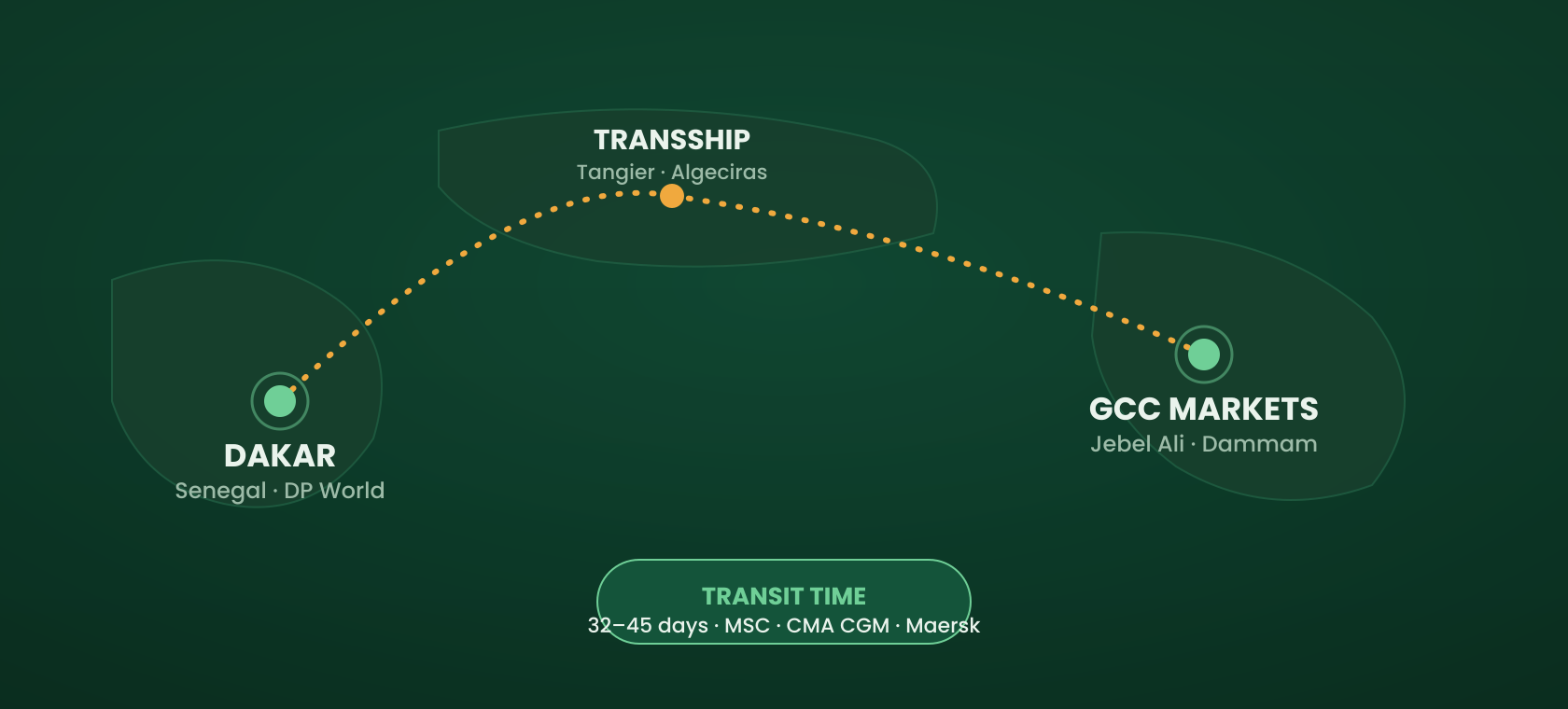
Cargo transships via Tangier, Algeciras and Valencia into GCC loops at Jebel Ali and Dammam - anchored by DP World's Dakar terminal.

Senegal to GCC shipping corridor
$340M
DP World investment in Dakar
850-900k
TEU annual capacity
32-45 days
Transit to the GCC
560
Reefer plugs · 13m draft
The Evidence Base

Independent research behind the thesis

Four pillars of the investment case, each supported by published government, multilateral and industry research.

USDA Foreign Agricultural Service, GAIN Reports

Saudi Arabia and UAE grain, feed and forage import annuals track Saudi Royal Decree M/19 and the related measures limiting domestic green fodder production in order to preserve non-renewable fossil aquifers.

The GCC meets a multi-million metric ton annual forage deficit almost entirely through sea-borne imports.

IMARC Group and Research and Markets

Saudi Arabia alfalfa hay market size and forecast, 2026 to 2034.  Demand is driven by commercial dairy operations optimising milk yield per cow.

Forecast growth above 5% CAGR through 2034, toward more than 4 million metric tons.

Mordor Intelligence

Global alfalfa market analysis, 2026 to 2031.  Shipping cost, tariffs and water rationing in major United States growing basins are pushing GCC buyers toward closer, lower-cost production hubs.

Dairy buyers increasingly contract on crude protein density and yield consistency rather than origin.

DP World disclosures and FAO West Africa frameworks

DP World reports capacity expansion at the Dakar Container Terminal and development of the Ndayane deep-water port.  FAO documents the structural forage shortage across the Sahel.

Dakar capacity beyond 800,000 TEU, with direct maritime access to Gulf ports.

Import Gap

3M+ metric tons

Combined Saudi and UAE annual green fodder import requirement under water conservation law.

Protein Benchmark

18% to 22% CP

Crude protein specification required by tier-one GCC dairy operations.

Corridor

Dakar to the Gulf

Shorter maritime route than West Coast United States or Australian origins.

Figures are drawn from the published sources named above and have not been independently verified by Bountiful Farms Inc.

Execution & Governance

Built for the specification the buyer actually contracts on

Growing the crop is step one.  Delivering it to Gulf specification, and holding the social licence that keeps the pivots running, is what makes the platform bankable.

Moisture control and processing at the farm gate

Meeting the export grade is a processing problem, not just an agronomic one.  Baling, drying and double-compression sit at the farm gate rather than downstream, which protects bale density and prevents the mould and heating risk that ruins forage in ocean transit.  Container specification is mapped for the Dakar route.

Community grazing and land rights governance

The 6,000 Ha low-input grazing and pond system is governed formally, not informally.  A community trust and joint advisory board with local herder co-operatives guarantees land access and water points in exchange for agreed boundaries around the commercial pivots, turning pastoralists into vested economic partners rather than a source of friction.

Institutional Readiness

Four things a lender asks before they read the agronomy

Development finance institutions and ESG mandates do not underwrite yield.  They underwrite carbon, customs, counterparty risk and freight density.  Each one is engineered into the plan rather than bolted on at diligence.

Carbon

Monetisable, not decorative

Alfalfa's protein content and digestibility reduce enteric methane per litre of milk relative to low-quality pasture, an effect published research places in the low double digits in percentage terms.  The Phase II solar microgrid displaces diesel combustion and yields verifiable Scope 1 reductions, and low-till pivot alfalfa acts as a continuous soil carbon sink.  Certifying the baseline early under a recognised standard such as Verra or Gold Standard converts all three into Verified Emission Reductions that Gulf off-takers and European buyers can apply against Scope 3.

Trade and tax

Investment Code status, and an input buffer

Formal status under the Senegalese Investment Code, administered through APIX, carries zero customs duty on imported capital equipment, including pivots, tractors, double-compression balers and solar modules, together with VAT relief through construction and expansion.  Nitrogen-fixing alfalfa cuts synthetic fertiliser demand, but imported non-dormant seed, fuel and pivot spares are held on site so that a bottleneck at the Port of Dakar never becomes a missed cutting.

Risk transfer

Parametric cover and political risk insurance

Parametric climate and drought cover, structured through African Risk Capacity or international reinsurers, pays out automatically against satellite vegetation indices or temperature thresholds, with no claims adjustment cycle to survive.  Political risk insurance through MIGA or the United States DFC covers expropriation, currency inconvertibility and transfer restriction, breach of the concession, and civil disturbance.  Both compress the margin a lender prices into the facility.

Density

Double compression is the freight economics

Shipping single-compressed forage across an ocean is uneconomic.  Single compression lands near 150 kg per cubic metre, roughly 12 to 14 metric tonnes in a 40ft high cube.  Double compression reaches 400 to 450 kg per cubic metre, roughly 26 to 28 tonnes in the same box.  That halves ocean freight per delivered tonne, and freight is the line that decides whether the landed margin survives the voyage.

Under NDA

Sizing and capital structure are not published here

Generation and storage capacity, the phased capital programme, the debt structure and the delivered-margin model are held in the data room rather than on a public page.  They are released to qualified counterparties under a non-disclosure agreement.

Request access

Enteric methane reduction from higher-quality forage is well established in direction, but the magnitude varies materially by ration, herd and measurement method, and is not presented here as a Bountiful Farms result.  Investment Code status, insurance placement and carbon certification are targeted structures, not completed ones, and are confirmed under diligence.

Phased & De-risked

A deliberate, de-risked path from restart to scale

A staged build develops the 2,000 Ha Phase I platform through 2030, then Phase II scales to 10,000 Ha under pivot irrigation.

FY2026

400 Ha
Restart - corn-led early planting.

FY2027-29

Ramp
Scale to 2,000 Ha; alfalfa leads.

FY2030

Steady state
First full year at 2,000 Ha.

Phase II

10,000 Ha
Pivot irrigation, biofuel & carbon.

Community & ESG

Lasting benefits for the Senegal River Valley

Beyond production and jobs, LFT invests in education, healthcare access and economic opportunity - partnering with trusted local organizations and community leaders.

Education & skills

Literacy, vocational & agricultural training for youth and women with Jeunesse Sénégal.

Healthcare

Maternal & child health - prenatal/natal exams, ultrasound access and transport.

Livelihoods

Grazing access, employment and entrepreneurship in modern, productive agriculture.

Leadership & Governance

A tier-1 team with 100+ years of combined applied experience

Operators who have built and run large-scale irrigated agriculture, backed by a board with sovereign-scale capital and resource expertise.

Operating leadership

Mike Rhodes
Chief Executive Officer

Mike Rhodes

40+ years in large-scale alfalfa & forage across Africa
  • Chief Executive of a large-scale African agriculture platform
  • Hands-on management of 16,000+ Ha across 8+ East & West African nations
  • 40+ years farming alfalfa & forage - from a family farm in Utah to commercial scale
  • Deep, active community engagement across Senegal & West Africa
Arama Kukutai
Executive Chair

Arama Kukutai

Two decades in agtech investment, farming & sustainability
  • Co-founder & Partner, Finistere Ventures - a leading agri-food-tech VC
  • Former CEO of Plenty; former Executive Chairman, PKW Farms (NZ)
  • Led New Zealand's Trade & Investment agency in North America
  • World Economic Forum contributor; World Class New Zealander (2022)
Connect on LinkedIn
Dr. Michael Pereira
Chief Agronomist

Dr. Michael Pereira

Irrigated forage agronomy, soil health & yield optimization
  • Directs the farm's agronomy program - crop selection & rotation
  • Leads soil optimization (AgLime, gypsum) & nutrient balancing
  • Expertise in alfalfa/forage production & precision irrigation
  • Champions digital agronomy & data-driven water management
Africa President

Gora Seck

Senegalese agricultural policy, government relations and community engagement
  • Africa President of the Company, based in Senegal
  • President of LFT Farms, the Saint-Louis concession holder
  • Maintains pivot production and continuity through the restart
  • Leads government, community and counterparty relationships in-country

Board of Directors

Russell Read
Vice Chair

Russell Read, PhD

40+ years institutional investing · sovereign & pension CIO
  • Former CIO - Alaska Permanent Fund, Gulf Investment Corporation (Kuwait) & CalPERS
  • Chaired the President's Working Group on Financial Markets under Treasury Secretary Paulson
  • Founder & Managing Partner, C Change Group - sustainable natural-resources infrastructure
  • PhD Political Economy (Stanford); MBA Finance (Chicago)
Connect on LinkedIn
Gary LaDrido
Board Member

Gary LaDrido

Impact investor · energy transition & climate-tech · $20B+ transactions
  • 20 years in Impact Investment Banking™; former Morgan Stanley Clean Energy Team
  • Board member, Agernomics - non-food energy crop feedstock for biofuel and sustainable aviation fuel
  • Advisory Board, Generation Food Rural Partners
  • Co-Chair, The WaterRising Institute and The WaterHouse - non-profit water access and resilience
Connect on LinkedIn

Executive and board biographies are drawn from public sources and company records.

Get in touch

Contact us

Tell us a little about you and we'll get back to you. For commercial, offtake, partnership, or media inquiries about Bountiful Farms and our Senegal platform.

Your message goes straight to our team. We treat all details as confidential.